Growing two crops together in the same field at the same time is not a new idea, and across much of sub-Saharan Africa it never went away. Maize with cowpea, maize with common bean, maize with pigeon pea, these are ordinary arrangements on ordinary farms, adopted long before anyone described them as sustainable intensification. The modern research interest is in whether the practice can be optimised, and if so, which management decisions actually move the outcome.
That question is harder to answer than it looks, because the published results disagree with each other. Two trials with apparently similar treatments in apparently similar environments can report an intercropping advantage of 40 percent and of nothing at all. The usual response is to pick whichever study matches the recommendation you already favour. The better response is to pool them formally and let the disagreement itself become part of the result.
An old practice and a modern question
The agronomic logic is straightforward. A legume growing beside a cereal fixes atmospheric nitrogen through its root nodules, which reduces the nitrogen the system has to buy. The two species occupy the canopy and the soil profile slightly differently, so the mixture can capture light, water and nutrients that a single crop would leave unused. A farmer also spreads risk, because two crops rarely fail in the same way in the same season.
The complication is that the same proximity that produces complementarity also produces competition. The legume that fixes nitrogen is also shading the maize and drawing on the same water. Whether the balance lands on the useful side depends on arrangement, on density, on which legume, and on what else is being applied. That is a management question, which is why the variability in the literature is the interesting part rather than a nuisance to be averaged away.
How you measure two crops at once
The standard instrument is the land equivalent ratio, proposed by Mead and Willey in 1980.1 It asks how much land you would need under sole cropping to produce what the intercrop produced on one hectare. An LER of 1.30 means a monoculture system would need 1.30 hectares to match what the mixture achieved on one. An LER of 1.00 means the mixture achieved nothing a sole crop could not, and below 1.00 the mixture is actively worse.
It is a useful measure with a known weakness. It is a ratio built from other ratios, it depends entirely on which sole-crop yields you compare against, and it says nothing about whether the two harvested products are equally valuable to the household. A high LER driven by a large cowpea yield is not the same proposition as a high LER driven by maize, if maize is what the family eats. Any honest account of intercropping has to carry that caveat rather than report the ratio as if it were profit.
What the synthesis found
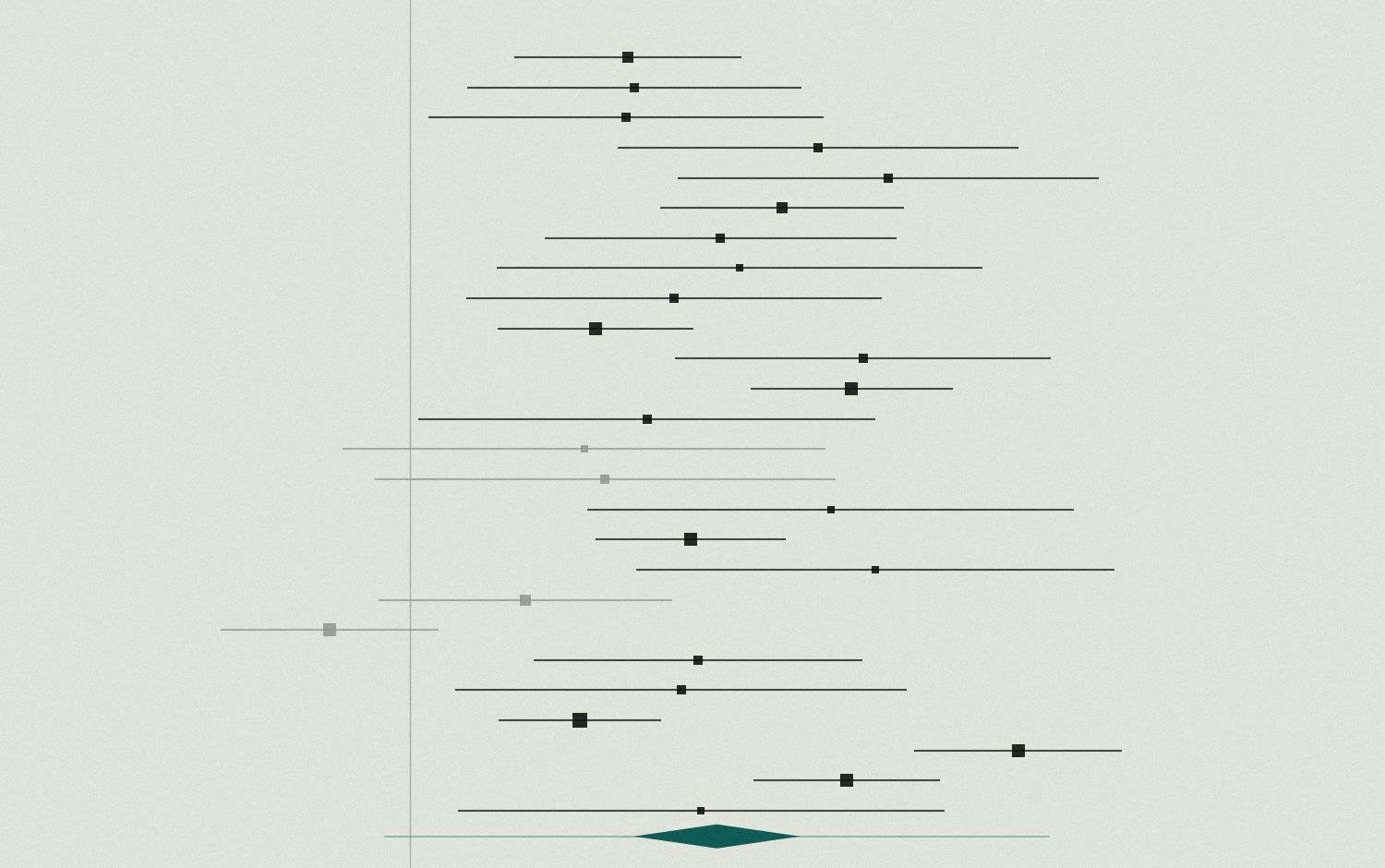
For my master's dissertation at the University of Edinburgh I assembled 69 sub-Saharan African field studies yielding 640 comparisons of intercrops against sole crops, and fitted multilevel random-effects models to log response ratios in R, using the metafor package.2,3 The multilevel structure matters, because a single study typically contributes several effect sizes, from several treatments across several seasons, and treating those as independent observations would make the result look far more precise than it is.
The pooled land equivalent ratio was 1.368, with a 95 percent confidence interval from 1.289 to 1.451. On average, then, these systems produced roughly 37 percent more per hectare than sole cropping would have. That is a substantial and statistically well-supported advantage, and it is the number that tends to get quoted.
The number that should be quoted alongside it is the prediction interval, which ran from 0.850 to 2.201. The confidence interval describes how precisely we know the average. The prediction interval describes the range in which a new trial, in a new place, under a new season, could plausibly land. Its lower bound sits below 1.0. That is not a flaw in the analysis, it is the finding. Intercropping is reliably beneficial on average and is not reliably beneficial everywhere, and a recommendation written as though the average were a guarantee will fail somebody.
The confidence interval tells you how well we know the average. The prediction interval tells you what could happen on the next farm. Only one of those is useful to a farmer.
Density did something interesting
Among the management variables tested, plant population density produced the clearest signal. Relative maize yield rose by 6.5 percent for every additional 10,000 plants per hectare, with a 95 percent confidence interval from 1.4 to 11.8 percent and a p-value of 0.012. The effect held when the analysis was restricted to a management-matched subset, which is the check that matters, because it addresses the obvious objection that denser plantings might simply co-occur with better farms and better management generally.
This is a practically useful result, because density is one of the few levers a smallholder can pull without spending money. Seed is already being bought. Spacing is a decision, not a purchase. An intervention that costs nothing but attention is worth more to a resource-constrained household than one that depends on input access, and it is precisely the sort of finding that gets underweighted in advice built around fertiliser and improved varieties.
Nitrogen did something suspicious
The nitrogen result is the one I find most worth writing about, because it is the one that would have been easiest to report wrongly.
Across the dataset, intercrop performance appeared to vary with nitrogen application rate in a way that looked, at first pass, like a crop response. It was not. The apparent gradient tracked study design rather than crop response. Trials applying higher nitrogen rates differed systematically from trials applying lower rates in other respects, and once that structure was accounted for, the nitrogen signal did not hold up as a causal statement about how these systems respond to fertiliser.
A meta-analysis that reported the raw gradient would have produced a clean, quotable, actionable and wrong recommendation about how much nitrogen to apply to a maize and legume intercrop. The distinction between a pattern in the data and a response in the crop is exactly what a synthesis exists to police, and it is the reason this kind of work is worth doing carefully rather than quickly.
What this means for advice
Three things follow, and none of them is "intercrop more".
- Report the spread, not only the mean. A pooled LER of 1.368 with a prediction interval crossing 1.0 is a different message from 1.368 alone. Extension material that carries the average without the variability sets farmers up to conclude the research was wrong when their own field lands in the lower tail.
- Lead with the free lever. If density carries a measurable effect and costs nothing, it belongs earlier in the advice than the recommendations that depend on purchased inputs.
- Be careful what you attribute to fertiliser. The nitrogen pattern in this literature is partly an artefact of how the trials were designed. Building a fertiliser recommendation for intercrops on the observational gradient across studies would not be justified by this evidence.
This synthesis is a master's dissertation, submitted in August 2026 and not yet peer reviewed, and it should be weighted accordingly. What it does establish is that the disagreement in the published record is not noise to be averaged away. It is the signal. The useful question was never whether intercropping works. It is which management configurations make the advantage reliable enough to recommend to somebody who cannot afford for it to fail.
Sources
- Mead, R. and Willey, R.W. (1980) The concept of a land equivalent ratio and advantages in yields from intercropping. Experimental Agriculture, 16(3), 217 to 228.
- Kimomo, C.M. (2026) Optimising management practices for maize and legume intercropping systems in sub-Saharan Africa. A meta-analysis. MSc dissertation, The University of Edinburgh, submitted August 2026. Not peer reviewed.
- Viechtbauer, W. (2010) Conducting meta-analyses in R with the metafor package. Journal of Statistical Software, 36(3), 1 to 48.