
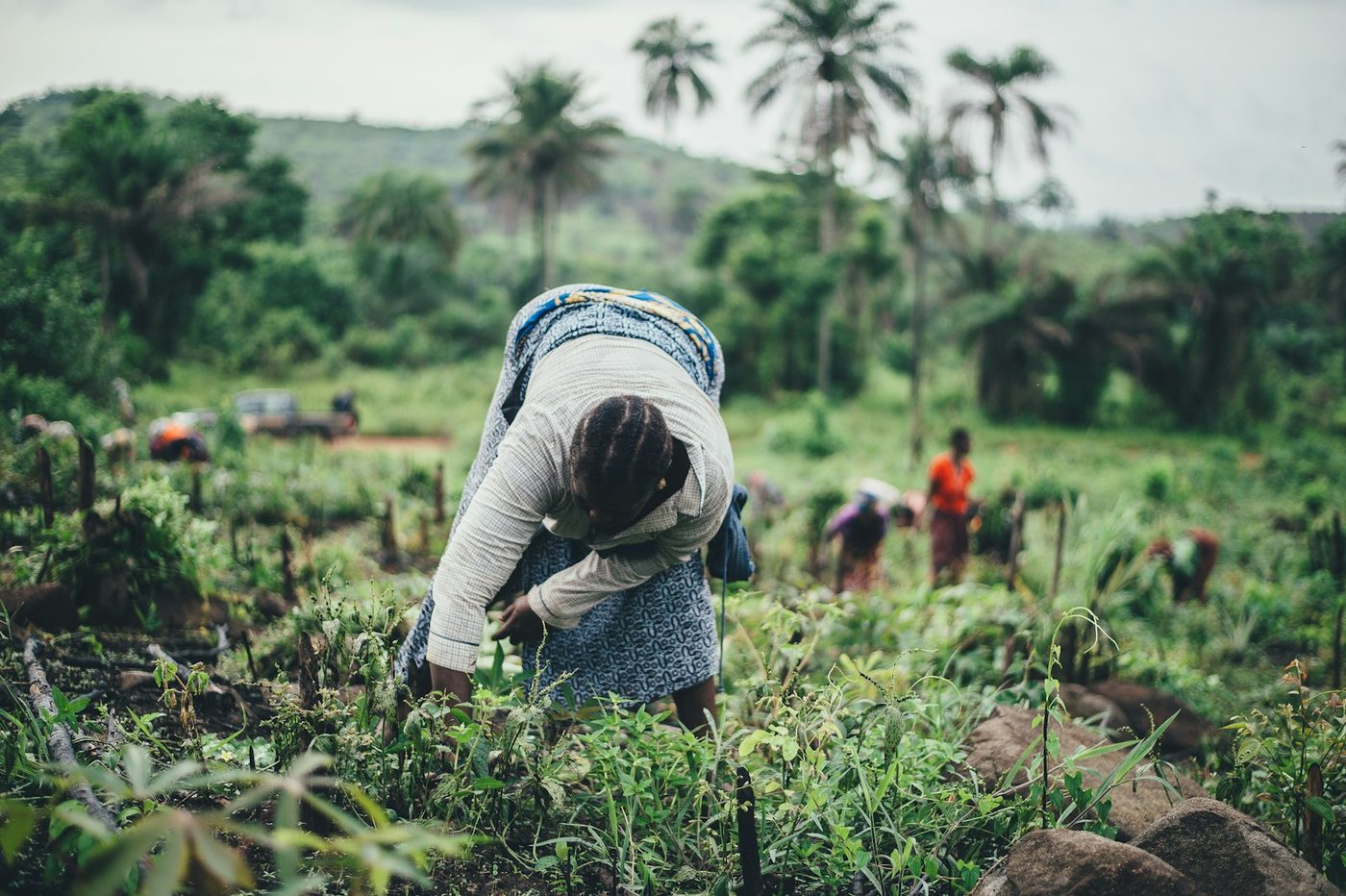
Walk across one smallholder farm in western Kenya and you can cross several different farms.
Near the house, where kitchen waste and manure have built up for years, the soil is darker and the maize taller. A few hundred metres away, on the outer fields, the same maize can look like a different crop.
This is not a figure of speech. When researchers measured it across farms in western Kenya, available phosphorus in the soil fell from 10.5 to 2.3 milligrams per kilogram between fields close to the homestead and fields further away. Without fertiliser, maize yields dropped from 2.59 to 1.59 tonnes per hectare. And the response to nitrogen was not the same everywhere either. In some districts it weakened with distance from the house, and in one it did not follow that pattern at all.
Now picture the fertiliser recommendation that reaches that farm. In most places it is one rate, for one crop, for a whole district.
It is wrong for the field by the house. It is wrong for the field at the far end. It may be right for almost nobody.
The line everyone skipped
In May 2024, African heads of state met in Nairobi for the Africa Fertilizer and Soil Health Summit. The headlines focused on a pledge to triple fertiliser production and distribution.
The commitment that caught my attention was quieter.
By 2034, at least 70 percent of smallholder farmers on the continent are meant to benefit from targeted agronomic recommendations for their specific crops, soils and climatic conditions.
Having worked in Kenya as an extension officer, a research and development officer and an agronomist, and then studied the evidence behind these recommendations at The University of Edinburgh, I think that line matters more than the tonnage. I also think it will fall short unless we are honest about what targeted advice actually demands.
Here is what I believe it will take.
1. Stop measuring advice in kilograms
In 2006, the Abuja Declaration committed African governments to raising fertiliser use to at least 50 kilograms per hectare by 2015. The International Fertilizer Development Center puts actual use at 8.0 kilograms in 2006, rising to 42.5 kilograms at its 2019 peak and falling back to 34.5 kilograms in 2022.
For almost twenty years, success has been counted in kilograms.
But a kilogram is not a recommendation. Whether a nutrient reaches the crop depends on four decisions, known in agronomy as the 4Rs. The right source, the right rate, the right time and the right place. Most advice specifies only one of them.
The cost of that gap is enormous. Raun and Johnson's widely cited estimate put nitrogen use efficiency for the world's cereal crops at about 33 percent. Roughly two thirds of the nitrogen applied was not recovered by the crop.
Tripling the amount without fixing the other three decisions risks tripling the waste.
2. Advise the field, not the district
The western Kenya findings point to something uncomfortable. The unit that matters for advice is not the country or the district. It is often the individual field.
That does not mean every field needs its own soil laboratory. It means recommendations should come in forms a farmer can match to their own land. Different advice for a fertile home field and a depleted outfield. Guidance on when manure or compost should come first, because on the poorest soils fertiliser alone can be money poured into the ground.
This is the heart of what soil scientists call integrated soil fertility management. Fertiliser, organic inputs and improved varieties, adapted to local conditions rather than applied from a single sheet.
3. Write advice that survives a bad season
A smallholder farmer is not trying to maximise average yield. They are managing cash, labour and rainfall at the same time, often with no savings to absorb a bad season.
A practice that raises yield in a good year but costs money up front, or loses everything in a dry one, can be a perfectly rational thing to refuse.
Targeted advice should be written for that reality. That means conditional recommendations rather than fixed ones, for example a second nitrogen top-dressing that depends on whether the rains have properly set in, instead of one amount decided before planting. And where a second purchase is out of reach, the advice should say what the best single application is, instead of describing an ideal the household cannot afford.
The question is not only whether a practice raises yield. It is whether it raises yield without raising the chance of loss.
4. Count farms, not messages
The 70 percent target will be monitored. How it is monitored will shape what gets built.
If success is counted in text messages sent or advisories published, the target can be met without a single farm changing. An honest measure asks three questions. Did the advice reach the farmer? Did the farmer use it? Did it improve yield, income or stability for that household?
It also has to run in both directions. Farms generate data every season on what was planted, applied and harvested. Most of it is collected for reports and never used again. Feeding it back into the models behind the recommendations is how advice gets better each year, instead of staying fixed for a decade.
In conclusion
Targeted advice is not a new technology. It is a change in what we accept as a finished recommendation.
A finished recommendation says how much, when, where and with what, for which kind of field, and with an honest sense of what could go wrong. Anything less is an average dressed up as advice.
Tripling fertiliser supply without that change risks repeating Abuja, with more tonnes and the same losses. With it, every kilogram does more work, on the field by the house and the field at the far end.
Join the conversation
I work on the evidence behind agricultural and food security recommendations, and I would be glad to hear from anyone working on this from the research, extension or policy side.
This article was first published on LinkedIn on 24 September 2026. Read the original and the discussion there.
Sources
- Vanlauwe, B., Tittonell, P. and Mukalama, J. (2006) Within-farm soil fertility gradients affect response of maize to fertiliser application in western Kenya. Nutrient Cycling in Agroecosystems, 76(2), 171 to 182.
- African Union (2024) Nairobi Declaration, Africa Fertilizer and Soil Health Summit, Nairobi, 7 to 9 May 2024.
- African Development Bank (2006) The Abuja Declaration on Fertilizer for an African Green Revolution.
- International Fertilizer Development Center (2024) Measuring fertilizer consumption progress in Africa.
- Raun, W.R. and Johnson, G.V. (1999) Improving nitrogen use efficiency for cereal production. Agronomy Journal, 91(3), 357 to 363.
- Vanlauwe, B. et al. (2010) Integrated soil fertility management. Operational definition and consequences for implementation and dissemination. Outlook on Agriculture, 39(1), 17 to 24.